Why visual legal guidance?
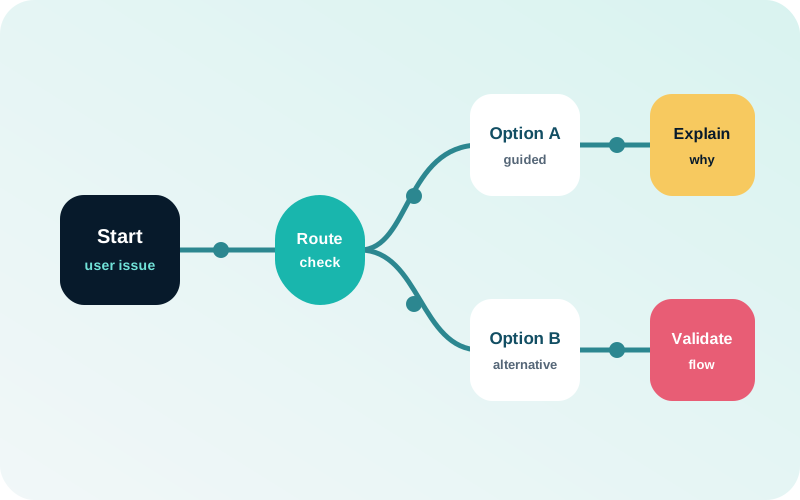
Legal processes are rarely linear. Different facts, deadlines, institutions and remedies can open or close possible routes. Conventional pages and static flowcharts struggle to provide both a coherent overview and personalised detail.
Design direction
LexVizExplorer treats legal guidance as a validated network of reusable process templates. Users can identify a relevant starting point through semantic and keyword selection, then explore a guided pathway with explanations at important decisions.
Semantic retrieval and keyword fallback help match user language to an appropriate legal flow.
Standardised identifiers support 50+ administrative-justice templates and reusable components.
Validation catches missing references, broken routes and structural inconsistencies before delivery.
Jest and Playwright tests protect behaviour as the knowledge base and interface evolve.
Technical focus
The platform combines a React and TypeScript interface with an Express/Node.js backend. Embeddings support semantic selection, while a non-destructive update strategy preserves existing retrieval data when new content is added.
The visual layer is designed around progressive disclosure: users see the immediate route and can reveal the reasoning, alternatives and contextual detail needed for deeper understanding.
Research questions
- How should complex legal pathways be represented without creating false certainty?
- Which explanations help non-experts understand why a route is available or unavailable?
- How can templates be validated, compared and reused across legal domains?
- Where should AI assist selection, and where should deterministic rules remain dominant?
Next steps
Current work focuses on stronger provenance, structured evaluation, accessibility, reusable data schemas and testing with legal experts and potential end users.